
"Reclining"
Oil on Canvas
11 x 14 in, 28 x 35 cm
2008

Modern Portraits
"Maxwell Stevens perfectly positions himself midway between figurative and abstract styles, skillfully and sensitively blending the two. His works arise from an interplay of emotions, ideas, and images, sometimes captured by chance and then elaborated by his creative mind. Step by step, idea by idea, Stevens generates multiple “moments” that become the subjects of his series of works, accompanied by philosophical reflections on specific themes, psychological aspects, the emotional tone of the imagery, and that cathartic emotional release that manifests through abstraction, as he himself has said."
-Beatrice Cordaro, Curator
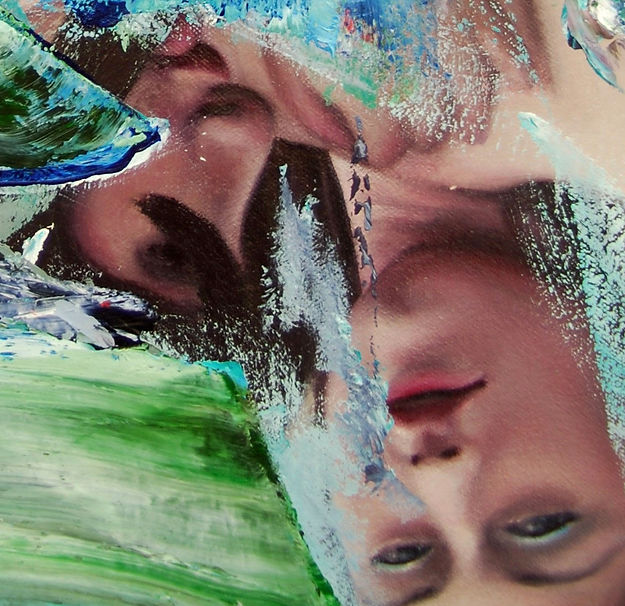
"Kamasutra Redux 11"(Detail)
Oil on Canvas
22.5 x 22.5 in, 58 x 58 cm
2007
"Regarding Stevens’ technique, many aspects stand out: from his inspiration, to his stylistic evolution, to his painterly gestures and color choices. His work, extremely analytical and coherent, treats brushstrokes almost as if they were written words; each brushstroke becomes a sentence that overlaps with others to compose visual narratives. Stevens’ brushstrokes are soft and balanced, but each possesses a different intensity: sometimes lighter, sometimes denser; sometimes slow, sometimes fast; sometimes careful, sometimes hasty. This approach makes his pictorial language particularly rich and dynamic. This reflection, together with other insights, has guided Stevens in creating and refining his personal technique, inspired by the great Italian, Spanish, and Dutch masters without ever slipping into mere quotation. This is a significant peculiarity: Maxwell Stevens draws lessons from the past but reworks them originally, building his own artistic signature through individual and in-depth study."
-Cordaro

"Kamasutra Redux 11"
Oil on Canvas
22.5 x 22.5 in, 58 x 58 cm
2007
"Some of Stevens’ oil paintings that merge figuration with abstraction sizzle with sexual innuendo while others convey sensations of stillness or communion amongst friends and family. Apt at close looking and a master of technique, he worked with figuration for many years but was tired of finding that his paintings could never quite fully reflect reality—which abstract painting, that captures essence and energy could do better...he has merged both, creating a palpable tension within the picture plane by this engagement with formalism but also its relationship to the subject matter." -Anna Mikaela Ekstrand, Editor of Cultbytes
"Thought processes of viewing others, in public, ignite as I gaze over the works. The truth that Stevens captures in his paintings is perhaps not, like a photograph, simply a representation of the visual scene itself, but instead the energy of those things and people who are keenly aware of being seen and those who are not...the tension between figurative and abstraction in Stevens’ works in this series lies in this uncertainty, of knowing and not knowing, concealing and revealing. The uncertainty of knowing if you are being watched, or the person you are looking at knows you are watching them, or if they even care. In public, we exist within our microcosms—a group of friends, family, or simply alone, but we are also visible to others and these microcosms can easily be punctured and expanded through conversation, gestures, or looks that allow our surroundings to shift."
-Ekstrand

"Evening" Oil on Wood, 2014 12 x 16 in, 30.75 x 41 cm

"Evening (second version)" Oil on Wood, 2014 12 x 16 in, 30.75 x 41 cm
"Evening" Oil on Wood, 2014 12 x 16 in, 30.75 x 41 cm
"Stevens’ painting technique has evolved over time thanks to continuous experimentation with color and brushwork. Mixing and layering have been constant analytical activities for him, mainly aimed at opening up to new stylistic and technical possibilities. His palette, composed mainly of oil paints, develops from careful observation of what he wants to represent, becoming always specific to each subject. From observing his works, it clearly emerges that nothing is left to chance. His compositional structure decisively integrates the choice of materials, the juxtaposition of brushstrokes, and the inclusion of elements that go beyond the traditional medium, that is, oil colors, showing a continuous propensity for experimentation without ever completely abandoning established techniques and styles."
-Cordaro
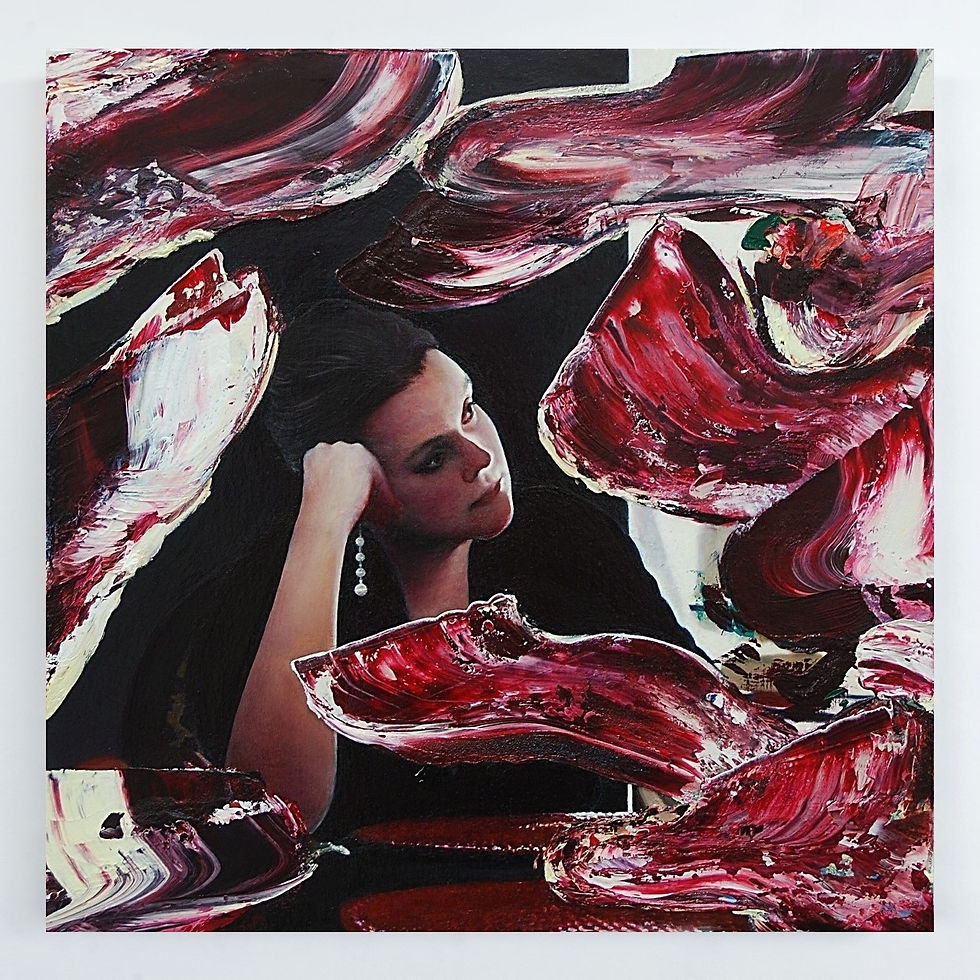
"Summer Table Closeup" Oil on Wood, 2012/2014 23 x 23 in, 51 x 51 cm
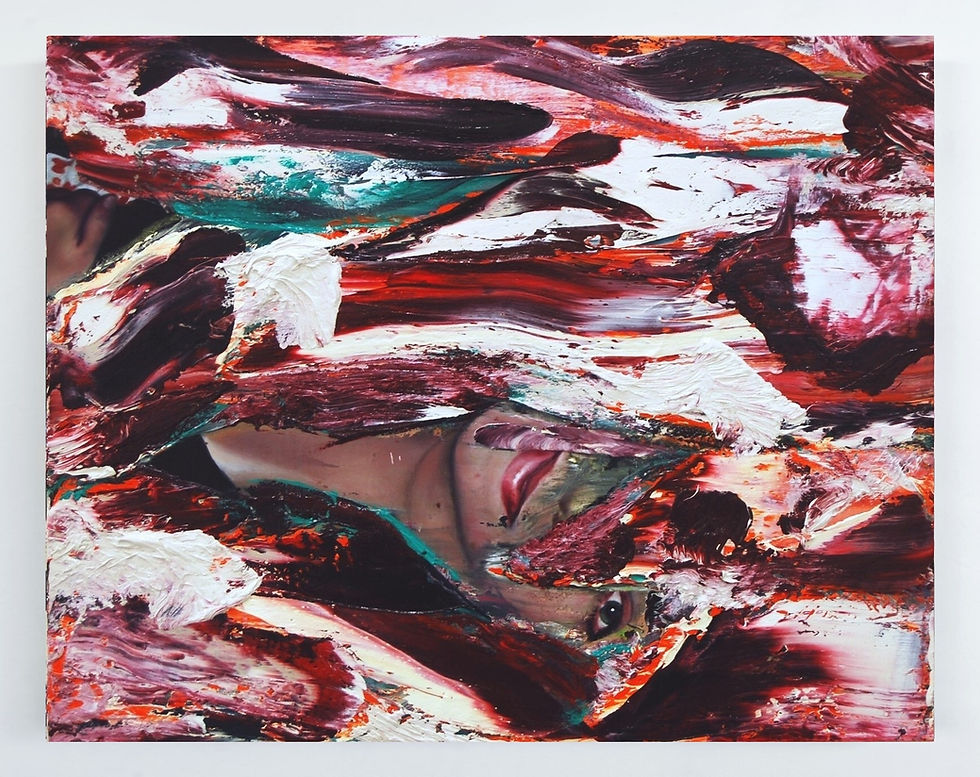
"Reclining (third version)" 2008 Oil on Linen, 15.75 x 19.75 in, 40 x 50 cm

"SES with Pearl Necklace" 2008 Oil on Panel, 10 x 8 in, 25.5 x 20.5 cm
"Summer Table Closeup" Oil on Wood, 2012/2014 23 x 23 in, 51 x 51 cm
"Stevens’ masterly painted images use a combination of realism and abstraction to create voyeuristic vistas of public yet private displays broken up by expressive sweeping gestures. His use of abstract, gestural marks break the 4th wall between the painting and the viewer, adding a fantastical and dream-like quality that forces the viewer to recognize the artificiality of the environment."
-Hayley Ferber, Curator, Pelham Art Center, New York

"Melancholy Eve 3" Oil on Hand-carved Mahogany, 2018 15.25 x 21.25 in, 39 x 54 cm

"Melancholy Eve 2" Oil on Hand-carved Mahogany, 2018 15.25 x 21.25 in, 39 x 54 cm

"Melancholy Eve 1" Oil on Hand-carved Mahogany, 2018 15.25 x 21.25 in, 39 x 54 cm
"Melancholy Eve 3" Oil on Hand-carved Mahogany, 2018 15.25 x 21.25 in, 39 x 54 cm
“I’m interested in the domestic arena as the primary site for our psychological and emotional experiences, and in how we exist differently, historically, within each passing moment. I try to use abstraction and the fragmentation of representational imagery to evoke this.” - Maxwell Stevens

"Shannon in Profile"
Acrylic on Birch
5.5 x 8.5 in, 14 x 21.5 cm
2017
"Just like German idealism produced the Strum und Drang (Storm and Urge) movement where edgy waves and curly clouds were set to express the noumenal beyond this world; Maxwell’s contemporary stance produces comparable contrapositions between realistic figures and tumultuous abstractions. The representational had to be present and it finally returned to his paintings thanks to a reconciliation with the power of the figure in admiring Rembrandt, Caravaggio, and Velázquez. These intimate, miniaturized portrayals are subsequently overpainted in thick impasto, fragmenting and disrupting the initially calm scenery. This interplay arrives at a newly hybridized pictorial space, one that makes allusions to both the Dutch Golden Age and to Abstract Expressionism, yet clearly would not exist in any other era than our own."
-Manuel Rodriguez, NY Arts Magazine
Related Publications
________________________________________
Cordaro, Beatrice. “Maxwell Stevens” Contemporary Art Explore, Vol.1. (Hardcover) Studioarte22, Italy. Published by Calaméo Press, Paris, France. May 20, 2023.
Rodriguez, Manuel. “Maxwell Stevens: Thesis, Antithesis & Synthesis” NY ARTS Magazine. March, 2016. Exhibition Review.
________________________________________